
When you walk into any science laboratory—whether in a school, university, or industrial research center—one item you will always find is a beaker. This simple piece of glassware plays a crucial role in scientific experiments and chemical handling. But what exactly makes beakers so essential? Let’s explore their purpose, types, and proper usage in the laboratory.
What is a Beaker?
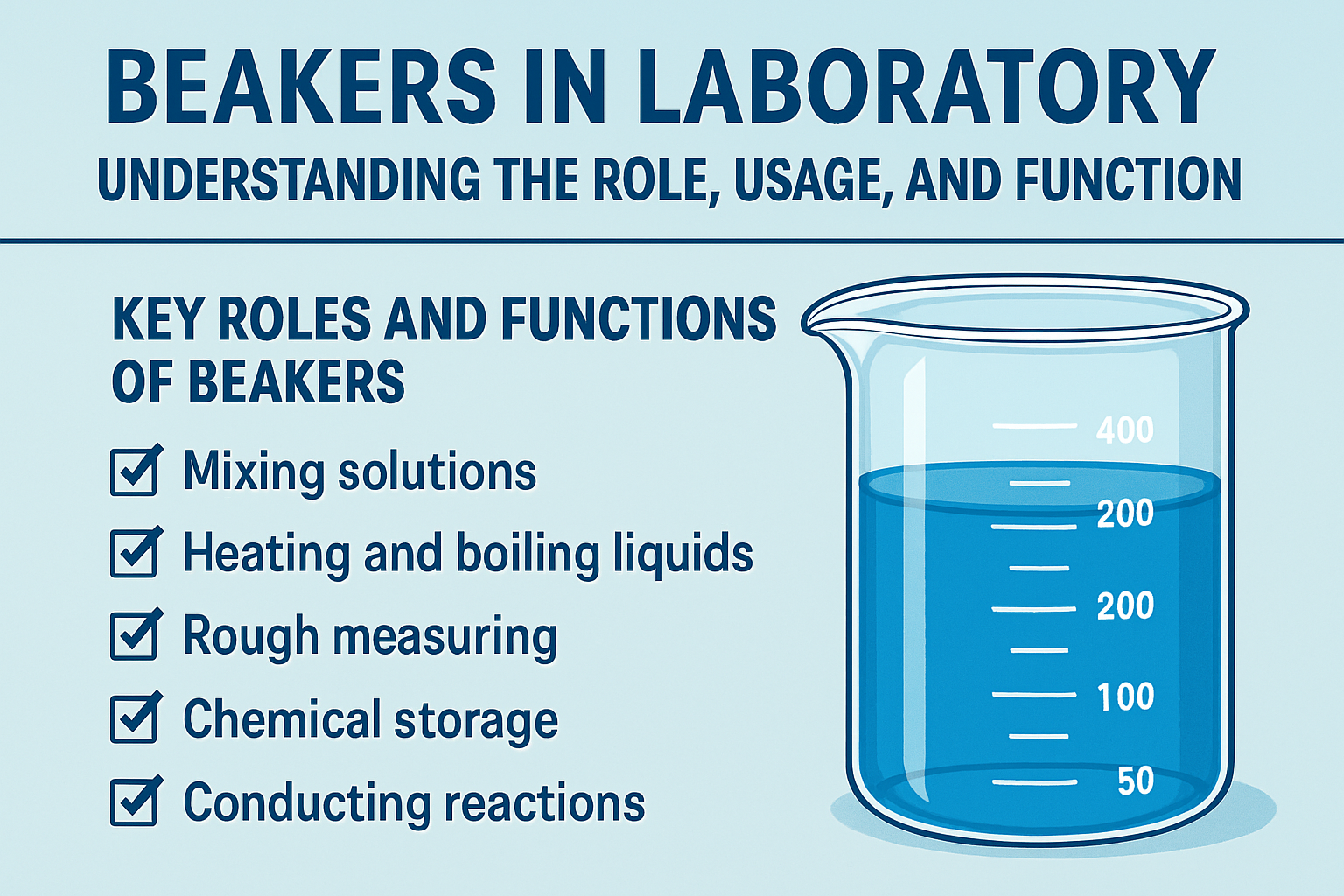
A beaker is a cylindrical container with a flat bottom, typically made of glass or durable plastic. It includes a small spout for easy pouring. Beakers are mainly used to hold, mix, heat, and measure liquids during experiments.
Common Types of Beakers
Beakers come in various shapes and materials based on the requirement:
| Type | Material | Usage |
|---|---|---|
| Glass Beakers | Borosilicate glass (like Pyrex) | Heating and chemical reactions |
| Plastic Beakers | Polypropylene or polycarbonate | Handling chemicals that react with glass or for lightweight needs |
| Tall-Form Beakers | Narrow and tall shape | Mixing chemicals with less evaporation |
| Low-Form Beakers | Wide and short shape | Easy stirring and heating |
Key Roles and Functions of Beakers
Beakers are versatile and used for many purposes:
- Mixing Solutions
They make it easy to combine liquids, chemicals, and reagents for reaction studies. - Heating and Boiling Liquids
Glass beakers can withstand high temperatures on Bunsen burners or hot plates. - Rough Measuring
Graduation marks on the side help estimate volume, though beakers are not used for precise measurement. - Chemical Storage
Temporary holding of liquids and samples during experiments. - Conducting Reactions
Open-top design is ideal for adding reagents and observing changes.
Why are Beakers Important in Laboratories?
Beakers provide:
Convenience for stirring, heating, and transferring substances
Visibility due to clear glass construction
Safety with heat-resistant and chemical-resistant materials
Their wide availability and strong structure make them one of the most commonly used lab tools worldwide.
Safety Tips While Using Beakers
To avoid accidents or contamination:
🔹 Handle hot beakers using tongs or heat-resistant gloves
🔹 Avoid sudden temperature changes to prevent glass cracking
🔹 Clean and dry beakers properly before reuse
🔹 Do not rely on graduation marks for accurate volume measurement
🔹 Use a stirring rod to prevent splashing when mixing chemicals
Conclusion
Beakers may seem like simple containers, but they are fundamental to almost every laboratory process. Their ability to hold, mix, heat, and observe chemical changes makes them an indispensable part of science. Understanding their proper usage not only improves experimental accuracy but also ensures safety in the laboratory.
Whether you are a student learning basic chemistry or a scientist conducting advanced research—beakers are always by your side, supporting countless discoveries!